
How to Tell When a Bearing Is Failing: Key Warning Signs
Date Posted: 24 August 2026
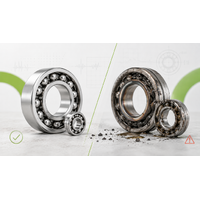

How to Tell When a Bearing Is Failing: Key Warning Signs
A failing bearing typically gives clear warning signs before it fails completely, including unusual noise, excessive heat, vibration, physical play, and grease contamination. Recognising these symptoms early can prevent costly unplanned downtime, secondary equipment damage, and serious safety incidents. Whether you're maintaining industrial machinery or diagnosing a vehicle drivetrain, this guide will walk you through how to identify bearing failure at every stage, and what to do about it.
What Are the Warning Signs of a Failing Bearing?
A failing bearing generally presents five key warning signs: abnormal noise, excessive vibration, elevated temperature, physical play or looseness, and changes in grease or lubricant condition. These symptoms rarely appear in isolation, most deteriorating bearings will show several signs simultaneously, and each symptom tends to worsen as the failure progresses.
Here is a quick-reference overview before we examine each in depth:
- Unusual noise: grinding, rumbling, squealing, or clicking sounds during operation
- Excessive vibration: felt through the housing, steering, or structure
- Elevated temperature: heat beyond normal operating range, burning smell, or discolouration
- Physical play or looseness: detectable movement beyond design clearance
- Grease or lubricant deterioration: darkened, gritty, or metallic-contaminated grease
1. Unusual Noise (Grinding, Rumbling, or Squealing)
Abnormal noise is the most common and earliest identifiable symptom of bearing failure. Bearing noise is typically speed-dependent, it increases in pitch or intensity as shaft or wheel rotational speed rises. This speed-dependence is one of the most reliable ways to distinguish bearing noise from other mechanical sources.
Different noise types point to different failure modes:
- Grinding or growling: Indicates metal-to-metal contact, most commonly caused by loss of lubrication or spalling, the process by which surface fatigue causes flaking of the bearing raceway or rolling elements, leaving rough, pitted surfaces that generate harsh contact noise.
- Low rumble increasing with speed: Suggests early-stage raceway damage or contamination introducing irregularities into the rolling path. This is often the first audible sign of developing failure.
- High-pitched squealing or screaming: Points to lubrication failure, misalignment, or an incorrect bearing type for the application. If the bearing is running dry, squealing can progress rapidly to grinding.
- Clicking or knocking: Often caused by cage fracture or foreign body contamination, debris caught between rolling elements produces irregular impact noise with each rotation.
In automotive applications, wheel bearing noise has a characteristic directional quality. If the noise changes intensity when cornering, louder turning left, quieter turning right, or vice versa, the load shift indicates which side bearing is affected.
2. Excessive Vibration
Vibration is caused by uneven load distribution resulting from damaged rolling elements, spalled raceways, or contamination particles within the bearing. As surface damage worsens, vibration amplitude typically increases.
In industrial machinery, vibration analysis equipment can detect bearing degradation weeks before it becomes audible, identifying characteristic frequency patterns associated with inner race, outer race, and rolling element defects. In vehicles, bearing-induced vibration is felt through the steering wheel, floorpan, or seat, typically as a rhythmic pulsing that increases with road speed.
If vibration is present but noise is minimal, also consider imbalance (typically felt as a consistent single-frequency vibration) or misalignment (often producing a vibration harmonic at twice rotational frequency) as alternative causes. A bearing fault tends to produce broader-spectrum, irregular vibration rather than a clean single frequency.
3. Elevated Temperature and Overheating
A failing bearing generates excess friction, which manifests as heat build-up in the bearing housing. According to bearing manufacturers including SKF and NSK, most standard bearings should not operate above 70–80°C under normal load and speed conditions. Temperatures beyond this threshold accelerate lubricant degradation, which further increases friction, a self-reinforcing failure cycle that, if unchecked, leads to rapid deterioration.
Secondary heat indicators include:
- Discolouration of the bearing housing: a blue or yellow tint on steel components indicates sustained high temperatures
- Burning smell: caused by lubricant breakdown and, in advanced cases, seal material degradation
- Lubricant bleed-out: heat-thinned grease weeping from seals
Use an infrared thermometer to compare bearing housing temperatures against adjacent components during operation. A bearing running significantly hotter than its surroundings, even without audible noise, warrants investigation.
4. Physical Play or Looseness
Worn bearings develop radial play (perpendicular to shaft axis) or axial play (along the shaft axis) beyond their designed internal clearance. Excessive play allows the shaft to move in ways it should not, which accelerates wear on surrounding components including seals, housings, and shafts.
To check for play manually, with the machine safely isolated:
- Wheel bearing check: Grip the tyre at the 12 and 6 o'clock positions and attempt to rock it. Any knocking sensation or visible movement indicates excessive radial play. Repeat at 9 and 3 o'clock to check axial play.
- Shaft bearing check: Attempt to lift and rock the shaft laterally. Movement beyond a fraction of a millimetre in a precision bearing is cause for concern.
Note that all bearings have some designed internal clearance, what you are looking for is play that produces a knocking or clunking sensation, which indicates wear beyond tolerance.
5. Grease or Lubricant Condition Changes
Grease inspection is an underused but highly effective diagnostic method. Healthy bearing grease should be smooth, uniform in colour, and consistent in texture. Signs of deterioration include:
- Darkened or black grease: Indicates oxidation, overheating, or contamination with wear debris
- Gritty or sandy texture: Suggests ingress of external contamination, dirt, water, or other particulates that act as abrasives on the rolling surfaces
- Metallic flakes or particles: A definitive indicator of internal wear, small metallic particles are generated as rolling elements and raceways degrade
- Grease leakage from seals: Indicates seal failure, which eliminates the protective barrier against contamination and allows further lubricant loss
Where accessible during scheduled maintenance, always inspect grease condition before re-greasing. Applying fresh grease over contaminated grease masks the problem without resolving it.
What Does a Failing Bearing Sound Like? (Noise Diagnostic Guide)
A failing bearing can produce several distinct sounds depending on the type and stage of failure. The table below summarises the most common noise types, their likely causes, and the urgency of action required.
| Noise Type | Likely Cause | Urgency |
|---|---|---|
| Deep grinding or growling | Metal-to-metal contact, spalling | High: replace soon |
| Low rumble increasing with speed | Early raceway or rolling element damage | Medium: monitor closely |
| High-pitched squeal | Lubrication failure, misalignment | Medium-High: inspect immediately |
| Intermittent clicking | Cage fracture, contamination ingress | Medium: inspect and assess |
| Knocking or thumping under load | Severe spalling, brinelling (indentation of the raceway caused by static overload or impact loading) | High: replace immediately |
Key diagnostic rule: If the noise changes pitch or intensity when the load direction changes, for example, when steering left versus right, the wheel bearing is almost certainly the source. Load shifting transfers stress from one side of the bearing to the other, momentarily relieving or increasing pressure on the damaged area.
How to Tell If It's a Bearing or a Belt Making Noise
Bearing noise and belt noise are frequently confused, particularly in automotive and industrial drive applications where both components operate in the same area. Each has distinct characteristics that allow them to be differentiated without specialist equipment.
Key Differences Between Bearing and Belt Noise
| Factor | Bearing Noise | Belt Noise |
|---|---|---|
| Behaviour on warm-up | Persists or worsens as temperature rises | Often disappears or reduces after warm-up |
| Relationship to speed | Increases proportionally with shaft or wheel speed | Linked to engine RPM and accessory drive speed |
| Behaviour under load | Changes with directional load (e.g., cornering) | Changes with accessory load (A/C, alternator engagement) |
| Character of sound | Grinding, rumbling, growling | Squealing, chirping, slapping |
| Response to lubrication | No change in noise | Squeal may temporarily stop |
To differentiate bearing from belt noise in practice: Apply a small amount of belt dressing spray to the running belt surface. If the noise stops or significantly reduces, the belt is the source. If the noise continues unchanged, the bearing is the more likely cause. *This test must only be performed with appropriate safety precautions and with all body parts and clothing kept clear of rotating components.
Unlike belt squeal, which typically disappears after the engine warms up and rubber compounds soften, bearing grinding or rumbling does not disappear after warm-up and typically worsens over time.
How to Check a Bearing for Failure: Step-by-Step
The following diagnostic process applies to both automotive wheel bearings and industrial machinery bearings. Always complete a full assessment rather than acting on a single symptom.
Can a Bearing Fail Without Warning Signs?
Yes, in some circumstances, bearings can fail suddenly with little or no prior warning. This most commonly occurs due to:
- Incorrect installation: Impact fitting without using proper pressing tools causes brinelling, the permanent indentation of the bearing raceway under shock load. The bearing may function briefly before failing suddenly.
- Sudden overload: A one-time shock load beyond the bearing's dynamic capacity can cause immediate internal fracture.
- Rapid contamination ingress: A seal failure that allows water, abrasive slurry, or other aggressive contaminants to enter the bearing can accelerate failure from weeks to hours.
However, the majority of bearing failures are progressive in nature, surface fatigue develops gradually, and the window between first detectable symptoms and catastrophic failure can be days to weeks. Condition monitoring technologies, including vibration analysis, infrared thermography, and oil/grease particle analysis, can detect bearing degradation significantly earlier than human senses, often weeks before audible symptoms emerge. Implementing predictive maintenance practices dramatically reduces the rate of unexpected sudden failures.
What Happens If You Ignore a Failing Bearing?
Ignoring bearing failure warning signs escalates both the severity of damage and the cost of repair, typically by an order of magnitude or more.
The typical progression of an ignored bearing failure runs as follows: surface fatigue develops → spalling begins as material flakes from the raceway → rolling element and raceway geometry degrades → vibration and heat accelerate → lubricant fails completely → seizure occurs.
The consequences of seizure extend well beyond the bearing itself:
- Shaft scoring and galling, requiring shaft replacement or expensive repair
- Housing bore damage, potentially scrapping the housing entirely
- Seal and lubrication system contamination, metallic debris circulates into connected systems
- In vehicles: wheel bearing seizure can cause sudden loss of vehicle control, a serious safety event
- In industrial machinery: bearing seizure can fracture shafts, damage gearboxes, overheat surrounding components, and in severe cases cause machinery fires
A bearing that costs £50–£200 to replace proactively may result in £2,000–£20,000 or more in collateral damage, labour, and downtime if it is allowed to seize. The case for acting on early warning signs is straightforward.
Frequently Asked Questions
How long can you drive on a failing wheel bearing?
Does a failing bearing always make noise?
What is the difference between spalling and brinelling?
How often should bearings be inspected?
Need Help Replacing a Failing Bearing?
Use the warning signs and inspection steps above to assess the bearing, then contact ReFast if you need help identifying a suitable replacement for your application.
Contact ReFast